June 10, 2026
How internally displaced women are being helped to cope with psychological challenges and improve their mental health
The war in Ukraine has had a profound impact on people, particularly those who have suffered and been forced to flee their homes. It has disrupted normal daily life and educational pathways, shattering family life and undermining mental health and a sense of stability. Research shows that during emergencies, people and adolescents who are aware of stress and its impact on their well-being, as well as those who have received psychological support, tend to demonstrate better mental health, greater resilience and better adaptation to change, as well as overall emotional well-being (Report of the 11th Meeting of the WHO Strategic and Technical Advisory Group of Experts for Maternal, Newborn, Child and Adolescent Health and Nutrition, 10–12 June 2025).
To support people experiencing such extraordinary circumstances, assistance is provided by government bodies and humanitarian organisations; however, given the significant needs and limited access to resources, this assistance is often insufficient.
In this context, it is becoming increasingly important not only to expand the scale of assistance but also to target it at the most vulnerable population groups. Women require particular attention, as in situations of forced displacement they often juggle multiple roles—caregiver, mother, breadwinner—yet remain underserved by systematic psychosocial support.
This is not merely a matter of responding to emergencies, but also of providing long-term assistance to vulnerable groups, which involves offering consistent psychosocial support to help them overcome life crises. In the context of war, the question arises: what does it mean, from the perspective of humanitarian interventions, to work with women and children in Ukraine today?
IDP women face not only the consequences of displacement and the loss of their homes, friends, and in some cases even relatives, but also with numerous difficulties: from work- or family-related stress to problems concerning economic opportunities, power cuts, threats to life from rocket attacks, illness, lack of heating and the challenges of integrating into new communities. According to a survey using the ‘WHO Well-being Index (WHO-5)’, which measures subjective mental well-being over the past two weeks, among IDPs only 30% of children feel calm, active and energetic; 67% of female respondents noted that their children are experiencing stress, and nearly 28% of adults reported their own anxiety and emotional exhaustion (data from ‘Mondo’, January 2026).
The difficulties described highlight not only the scale of the problem, but also the need for systematic, practical approaches that enable women to receive support and gradually regain the ability to cope with stress on their own. For example, in the Dnipropetrovsk and Zaporizhzhia regions, silence is a relative concept: explosions and air-raid sirens remain part of everyday life here. Many internally displaced persons did not travel hundreds of kilometres, but moved within their own region or to a neighbouring one, hoping to get at least a step away from danger. As a result, IDPs remain under the influence of stress linked to the war. People who left their homes and everything they had built up for the sake of their own safety and that of their children have, unfortunately, not found it in full.
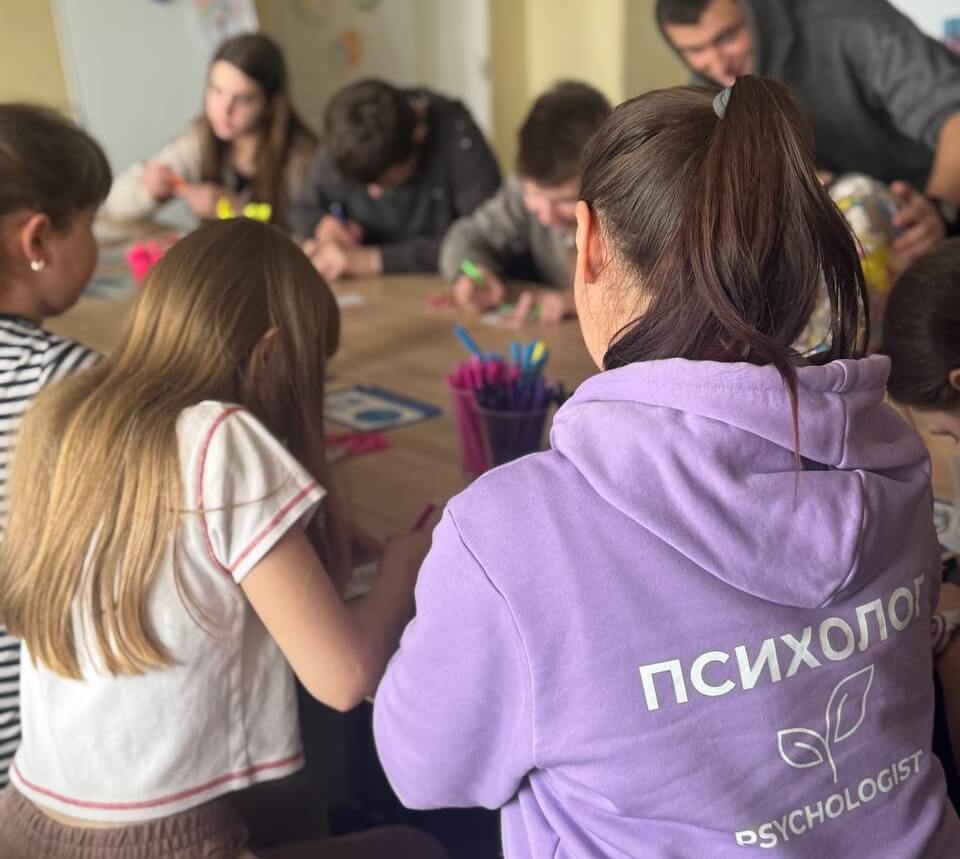
As part of the project ‘Providing non-food items and psychosocial support to vulnerable women and children in IDP shared accommodation facilities in Ukraine’, implemented by the non-governmental organisation ‘Mondo’ with the support of the Estonian government and donations from French citizens, psychosocial sessions are being held in 11 temporary accommodation sites in the Dnipropetrovsk and Zaporizhzhia regions. A mobile team of psychologists from the partner civil society organisation “Sonce UA” conducts art therapy sessions, during which they teach participants how to manage stress independently and provide practical knowledge on ensuring psychological safety.
These sessions evoke a wide range of emotions in the participants — from a sense of calm to a feeling of empowerment. Women in various situations join the programmes: some have become completely disillusioned with people and feel utterly powerless, left alone with their problems; some are depressed and seem emotionally numb, unable to cope with the strain; and some are already experiencing clear symptoms of depression — chronic fatigue, loss of interest in life, problems with sleep and eating, psychosomatic illnesses and apathy.
“When you live in a hostel where the kitchen, shower and toilet are shared — one per floor or even for the whole building — and you’ve also been through extremely difficult circumstances, it’s very hard to find the resources to support yourself. It’s hard even to feel in control of your own life,” notes Marina, a psychologist with the NGO “Sonce UA”.
The programme creates a safe, accepting space where women gradually open up during art sessions, begin to trust, and feel their own worth and zest for life.
Psychologists from the mobile team of the NGO “Sonce UA” also work with teenagers and children of IDPs. They note that children often struggle with their emotional state and experience social rejection, which negatively affects their self-esteem.
As internally displaced persons, they often face bullying and discrimination from their peers. Families who were already in difficult circumstances before the full-scale invasion often find themselves in an even more vulnerable position as a result of displacement.
In the absence of adequate support and acceptance from adults and peers, children may feel lonely and unwanted, although they do not always show this outwardly. “We create a safe, friendly environment, we do not judge and we ensure equal opportunities, at least during our sessions, allowing children to feel important and needed. We hope this has a positive impact on their psychological well-being,” says Olga, a psychologist at “Sonce UA”.
In April alone, psychologists carried out 23 visits and 46 group sessions for children and women, reaching 299 beneficiaries among internally displaced persons temporarily residing in shelters in Dnipropetrovsk and Zaporizhzhia regions. Among the participants were 12 people with disabilities. Psychologists observed a gradual increase in participants’ interest in life; however, symptoms such as hypersensitivity, sadness, exhaustion and loneliness remain common. For children, the opportunity to communicate and interact with trusted adults during sessions with psychologists they can confide in is particularly valuable.
Children’s group sessions are held as part of the ‘Colourful Stories’ and ‘Journey into Space’ programmes. Through the use of imaginary worlds, planets and storytelling, children can distance themselves from stress and symbolically express their experiences. These activities involved body-oriented and creative practices to restore a sense of safety, self-worth and emotional warmth. The sessions helped with emotional relief, activating personal resources and strengthening inner resilience. One of the key outcomes of these art therapy sessions is grounding — bringing attention back to the ‘here and now’ rather than getting lost in feelings of uncertainty, anxiety and confusion.
“It’s as if I’m unhooking myself from negative thoughts and feelings when I’m doing something with my hands or daydreaming,” — Lyudmila, 42.
“When we get together for sessions with the psychologists, we don’t notice how time flies. We talk about everything, even topics we’ve kept quiet about for a long time. The girls understand us,” — Maria, 67, IDP.
The group format helps foster an atmosphere of trust and mutual support, which is particularly important in conditions of social isolation and the loss of familiar social roles. Creating a safe, accepting environment allows women to feel their own worth, significance and sense of belonging to the community. In addition, women have to provide support to their children, who face emotional difficulties, rejection or bullying, problems with self-esteem, anxiety and panic attacks. For children, support from adults plays a key role in overcoming these difficulties. In some cases, lacking their own resources, women become trapped by feelings of guilt, which exacerbates their psychological distress.
The resource-based art therapy programme ‘Recovery through Creativity’ serves as a comprehensive psychosocial intervention that addresses the current challenges of wartime and the needs of internally displaced women living in compact settlements. In the context of a war that has disrupted life trajectories, led to the loss of homes, social connections and a sense of stability, the development of psychological self-help skills takes on particular importance.
The programme is structured as a sequential process: from creating a safe space and reducing anxiety to recognising one’s own resources, re-establishing psychological boundaries, developing self-support and shaping a vision of the future. In this process, art therapy serves as an accessible and holistic tool, enabling participants to express complex emotions, reduce emotional tension and reconnect with themselves.
Practical experience of implementing the programme shows that, through creative activities, women gradually acquire psychological self-help skills. They learn to stay grounded, better understand their emotions and find inner strength even in difficult life circumstances. As the participants note, the creative process helps them let go of negative thoughts, feel empowered and supported, and regain the ability to speak openly about their own experiences.
Overall, the ‘Recovery through Creativity’ programme demonstrates the potential of art therapy as an effective approach to the gentle, non-violent restoration of the psycho-emotional state of women who have survived traumatic experiences, and facilitates their gradual reintegration into active social life.
The success of psychosocial programmes, such as the one implemented by Mondo, is evidenced by the solidarity among IDP women, their ability and desire to carry on living, to endure hardship and to build a new reality. The key value of such initiatives lies in the fact that they do not replace external support, but make people less dependent on it, restoring what matters most — a sense of strength, dignity and inner resilience.
Author of the article: Kateryna Ihnatenko
Mental Health Expert in Ukraine